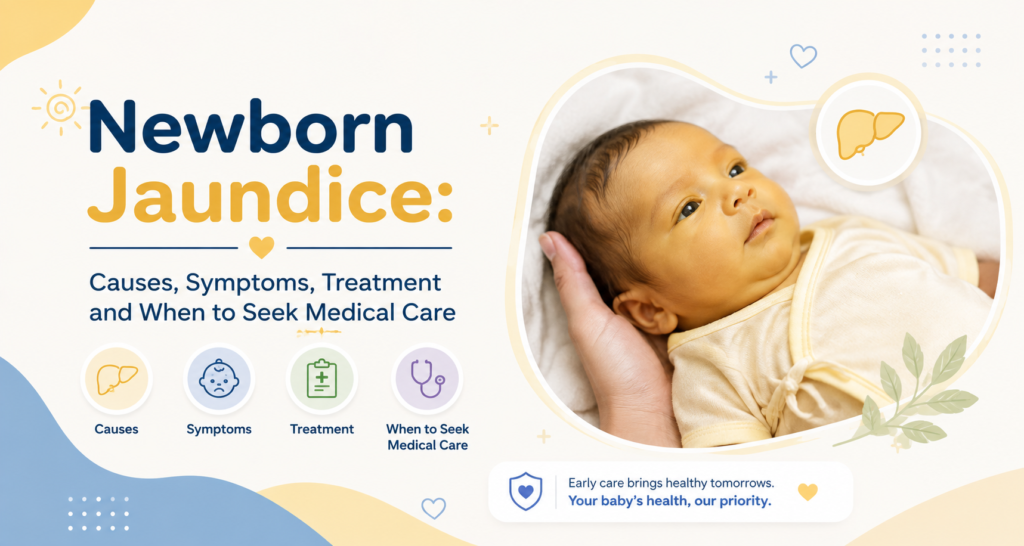
Newborn Jaundice: Causes, Symptoms, Treatment and When to Seek Medical Care
Newborn jaundice is a common condition that causes a baby’s skin and the whites of the eyes to appear yellow. It usually develops during the first few days after birth and often improves as the baby’s liver becomes more mature. However, significant or rapidly increasing jaundice requires medical assessment because very high bilirubin levels can potentially affect the brain.
For parents, knowing what causes newborn jaundice, how it is diagnosed, and when treatment is required can provide reassurance and help ensure timely medical care. At Aspire Children’s Specialty Centre, families can access specialized newborn jaundice treatment in Calicut with neonatal evaluation, bilirubin monitoring, and appropriate treatment when required.
What Is Newborn Jaundice?
Jaundice occurs when bilirubin, a yellow substance produced when red blood cells break down, builds up in the baby’s blood. Newborns are particularly prone to this because their liver is still developing and may not process bilirubin as efficiently as an older child’s or adult’s liver.
Some degree of jaundice is common during the first week of life. However, the level of bilirubin, the baby’s age in hours, gestational age, feeding pattern, and other risk factors are important when deciding whether treatment is needed.
What Causes Jaundice in Newborns?
There are several possible causes of newborn jaundice.
Physiological Jaundice
This is the most common type and is related to the normal adjustment of the baby’s body after birth. It generally appears after the first day of life and improves as the baby’s liver matures.
Feeding-Related Factors
Poor feeding can contribute to increased bilirubin levels. Ensuring adequate feeding and appropriate breastfeeding support is an important part of preventing and managing significant hyperbilirubinemia.
Blood Group Incompatibility
If the mother’s blood type and the baby’s blood type are incompatible, increased breakdown of red blood cells can sometimes lead to higher bilirubin levels.
Prematurity
Premature babies may have a higher risk of significant jaundice because their liver and other systems are less mature.
Other Medical Conditions
Infections, red blood cell disorders, and certain liver or metabolic conditions can also contribute to jaundice and may require additional investigation.
How Can Parents Recognize Jaundice?
The most noticeable sign is a yellow colour of the skin or the whites of the eyes. Jaundice may begin on the face and become more noticeable over the body as bilirubin levels increase.
Parents should seek medical advice if:
- The yellow colour appears during the first 24 hours after birth
- Jaundice appears to be getting worse
- The baby is difficult to wake
- The baby is feeding poorly
- The baby appears unusually sleepy or weak
- The urine is dark
- The stools are unusually pale
Jaundice in a baby younger than 24 hours requires prompt medical assessment.
How Is Newborn Jaundice Diagnosed?
Doctors do not determine the severity of jaundice simply by looking at the baby’s skin. Bilirubin levels may be assessed using a transcutaneous bilirubin measurement or a blood test for total serum bilirubin.
The bilirubin result needs to be interpreted according to the baby’s age in hours and other clinical factors. This is why professional assessment is important before deciding whether treatment is necessary.
Depending on the situation, doctors may also recommend additional tests to identify an underlying cause.
When Does Newborn Jaundice Need Treatment?
Many newborns with mild jaundice do not require specific treatment. They may simply need appropriate feeding support, monitoring, and follow-up.
When bilirubin reaches a treatment threshold, phototherapy is commonly used. Phototherapy uses a special type of light to help the baby’s body process bilirubin so it can be eliminated more effectively.
In rare cases of severe hyperbilirubinemia, more intensive treatment may be required. The exact treatment depends on the baby’s bilirubin level, age, gestational age, and risk factors.
This is why timely newborn jaundice treatment in Calicut should always be based on professional evaluation rather than home remedies or visual assessment alone.
How Can Parents Support a Baby With Jaundice?
Parents can support their baby’s recovery by following the feeding and follow-up recommendations provided by their healthcare team.
Important steps include:
- Feed the baby regularly as advised
- Monitor feeding and urine output
- Attend recommended bilirubin checks
- Follow phototherapy instructions if prescribed
- Attend follow-up appointments
- Seek medical attention if jaundice worsens
Parents should not expose a jaundiced newborn to direct sunlight as a substitute for medically indicated phototherapy.
Can Newborn Jaundice Be Serious?
Most newborn jaundice is mild and resolves with appropriate monitoring. However, very high bilirubin levels can cause bilirubin encephalopathy and, in severe cases, kernicterus, a form of permanent neurological injury.
The risk is one reason early identification, bilirubin monitoring, and appropriate treatment are important.
Why Choose Aspire for Newborn Jaundice Care?
Aspire Children’s Specialty Centre provides specialized newborn and neonatal care supported by experienced pediatric and neonatal specialists.
Families seeking newborn jaundice treatment in Calicut can benefit from:
- Specialized neonatal assessment
- Bilirubin monitoring
- Advanced newborn care facilities
- Phototherapy when clinically indicated
- Experienced neonatology specialists
- Follow-up support for newborns and parents
Aspire’s approach focuses on identifying babies who require treatment while avoiding unnecessary intervention when observation and feeding support are sufficient.
When Should Parents Contact a Doctor?
Parents should seek prompt medical attention if a newborn develops jaundice during the first 24 hours, becomes increasingly yellow, feeds poorly, is unusually sleepy or difficult to wake, develops breathing difficulty, or shows other concerning symptoms.
Early evaluation can help doctors determine whether the jaundice is part of a normal newborn transition or whether further investigation and treatment are needed.
FAQs
What causes jaundice in newborn babies?
Newborn jaundice is usually caused by a temporary buildup of bilirubin because a baby’s liver is still developing. Prematurity, feeding difficulties, blood group incompatibility, infections, and certain medical conditions can also contribute.
When should a baby with jaundice see a doctor?
A baby should be assessed promptly if jaundice appears within the first 24 hours, becomes worse, or is accompanied by poor feeding, unusual sleepiness, difficulty waking, breathing problems, dark urine, or pale stools.
How is newborn jaundice tested?
Doctors may measure bilirubin using a transcutaneous bilirubin device or a blood test. The result is interpreted according to the baby’s age in hours and other risk factors.
Does every baby with jaundice need phototherapy?
No. Many babies with mild jaundice only require feeding support and monitoring. Phototherapy is recommended when bilirubin reaches the appropriate treatment threshold based on the baby’s clinical circumstances.
Where can I get newborn jaundice treatment in Calicut?
Aspire Children’s Specialty Centre provides specialized neonatal assessment, bilirubin monitoring, phototherapy when required, and comprehensive newborn care.
Conclusion
Newborn jaundice is common, but it should never be ignored when symptoms are significant or worsening. Proper assessment of bilirubin levels, regular feeding, monitoring, and timely treatment can help protect a baby’s health.
For parents looking for reliable newborn jaundice treatment in Calicut, Aspire Children’s Specialty Centre provides specialized neonatal evaluation and comprehensive newborn care.
